+0.00m / LIFT LOBBY
Accessible wayfinding
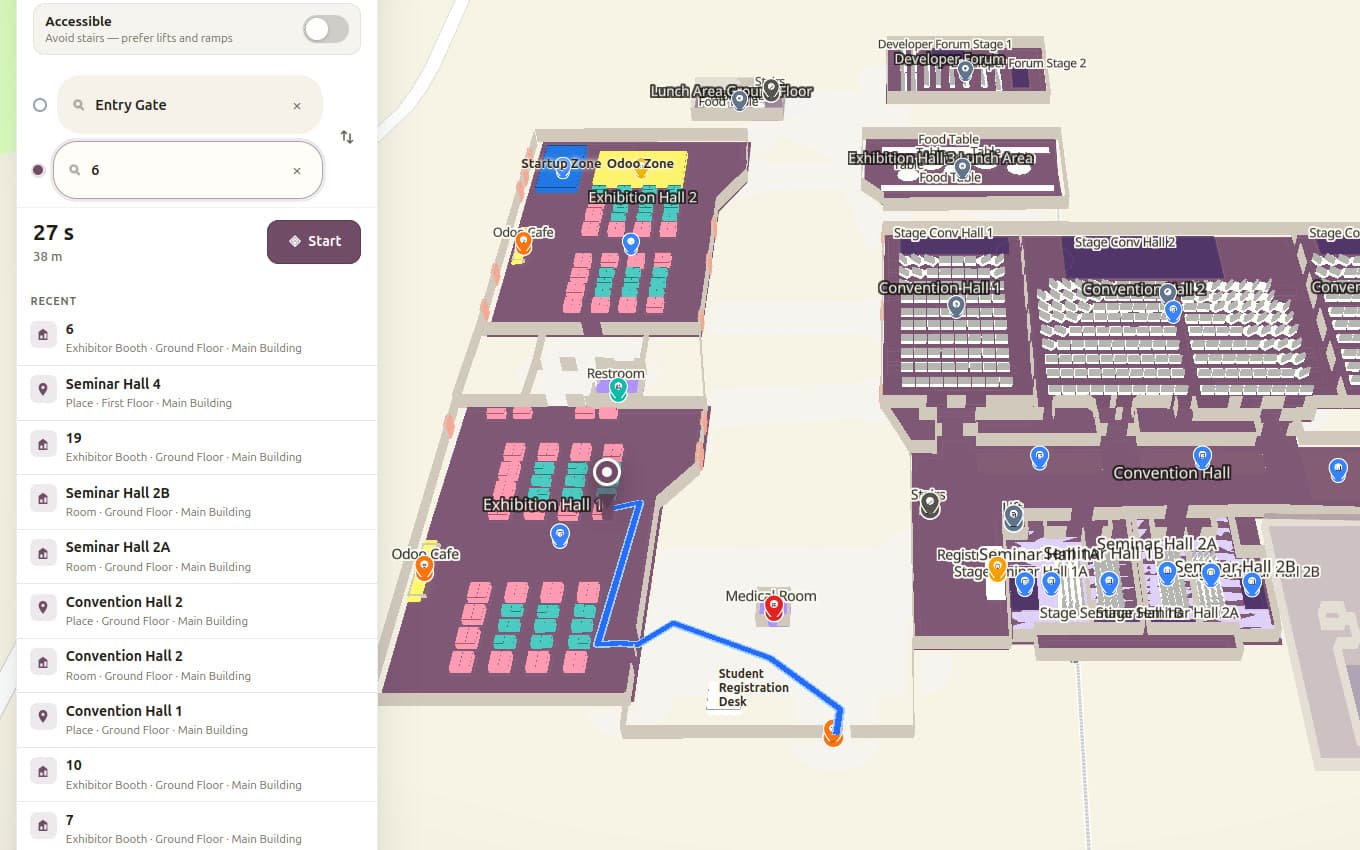
Accessible wayfinding gives people with disabilities usable routes through a venue: step-free paths, lift-first routing, clear landmarks and screen-reader-compatible directions. Venues use it to meet legal obligations and to make buildings genuinely navigable for everyone who enters them.
A route that ends at a staircase is not a route for everyone. Accessibility here is a routing option, a content standard and a testing discipline.
+0.00m / LIFT LOBBY
What it does
Step-free routing
Any route can be requested step-free; lifts, ramps and level entrances are modelled with their real locations.
Screen-reader directions
Turn-by-turn instructions are real text in the DOM, written to be read aloud, not captions on a picture.
Landmark-based guidance
Directions reference what a person can perceive — 'past the pharmacy window' — not compass bearings.
Accessible venue data
Accessible toilets, hearing loops, quiet rooms and changing places are mappable attributes, searchable like anything else.
WCAG-conformant surfaces
Kiosk UI, mobile UI and this website target WCAG 2.2 AA. Current audit status: TBD.
Tested with users
Accessibility claims get tested with disabled users, not just linted. Testing programme status: TBD.
LIVE LAYER
Accessibility data stays current the same way booths do: when facilities logs a lift outage, step-free routes re-plan around it automatically.
+0.00m / EXIT
See your venue as your visitors will
Open a venue that is running right now, book a walkthrough, or start free with your own floor plan.